Wheel-thrown and Altered as a fundamental process for truth.
Adapting Wheel-thrown and altered form as a practice for truth seeking
I was in my second year of biochemistry when I took a handbuilding class as an elective. I did not go in expecting much from it. I thought it would sit beside the rest of my coursework and then pass. That did not happen. I saw, pretty quickly, that vessel forms and body forms were tied to each other in ways I had not taken seriously before. I also learned that some of the earliest clay objects were already doing that work. They were not only containers. They were ways of thinking about the body. That shifted my attention.
At the time, I was already losing faith in the path I had set for myself in medicine or research. I was learning a lot about how the body works, but I felt a gap between that knowledge and the kinds of pain I kept noticing around me. A lab can measure function. A clinic can treat symptoms. I do not doubt the value of either. Still, I had started to feel that much of what harms us is carried through family, culture, labor, language, and belief. I could not find a way into that through science alone. Clay gave me one.
I work with wheel thrown and altered forms because I have found that the process shows stress clearly. It does not hide cause and effect. I throw a cylinder. It starts centered, upright, and even. The walls are continuous. The body holds. At that point the form is simple, but not empty. It already has an inside and an outside. It has a mouth, a wall, a base, and a limit. It can contain volume. It can fail. I learned a lot from that.
Then I press on it, cut it, collar it, or shift its axis. That is where the work becomes useful to me. I am not interested in keeping the form clean just because I can. I start with control, then I test it. I want to see what happens when a stable body meets force.
I work mostly in porcelain and porcelaneous stoneware. I chose them because they record pressure with very little mercy. I saw this early on with porcelain. If I hesitated, the wall showed it. If I overworked a rim, it thinned out and sagged. If I pushed a shoulder too far, the weakness carried through the whole form. Porcelaneous stoneware gives me some of that same clarity, but it will tolerate more before it fails. That difference matters in the studio. It lets me decide how much risk I want to take and where.
I alter at several stages because each stage gives me a different kind of information. When the clay is wet, it moves easily and fails fast. I can stretch a wall a lot in a few seconds, but I can also lose the whole piece in one bad push. At soft leather hard, I can cut and rejoin with more precision. The clay still remembers the wheel, but it has enough structure to hold a sharper change. At stiffer leather hard, the form pushes back. Seams open. Attachments crack off. Rims split. I have come to trust that stage because it tells me more honestly what the material will and will not accept.
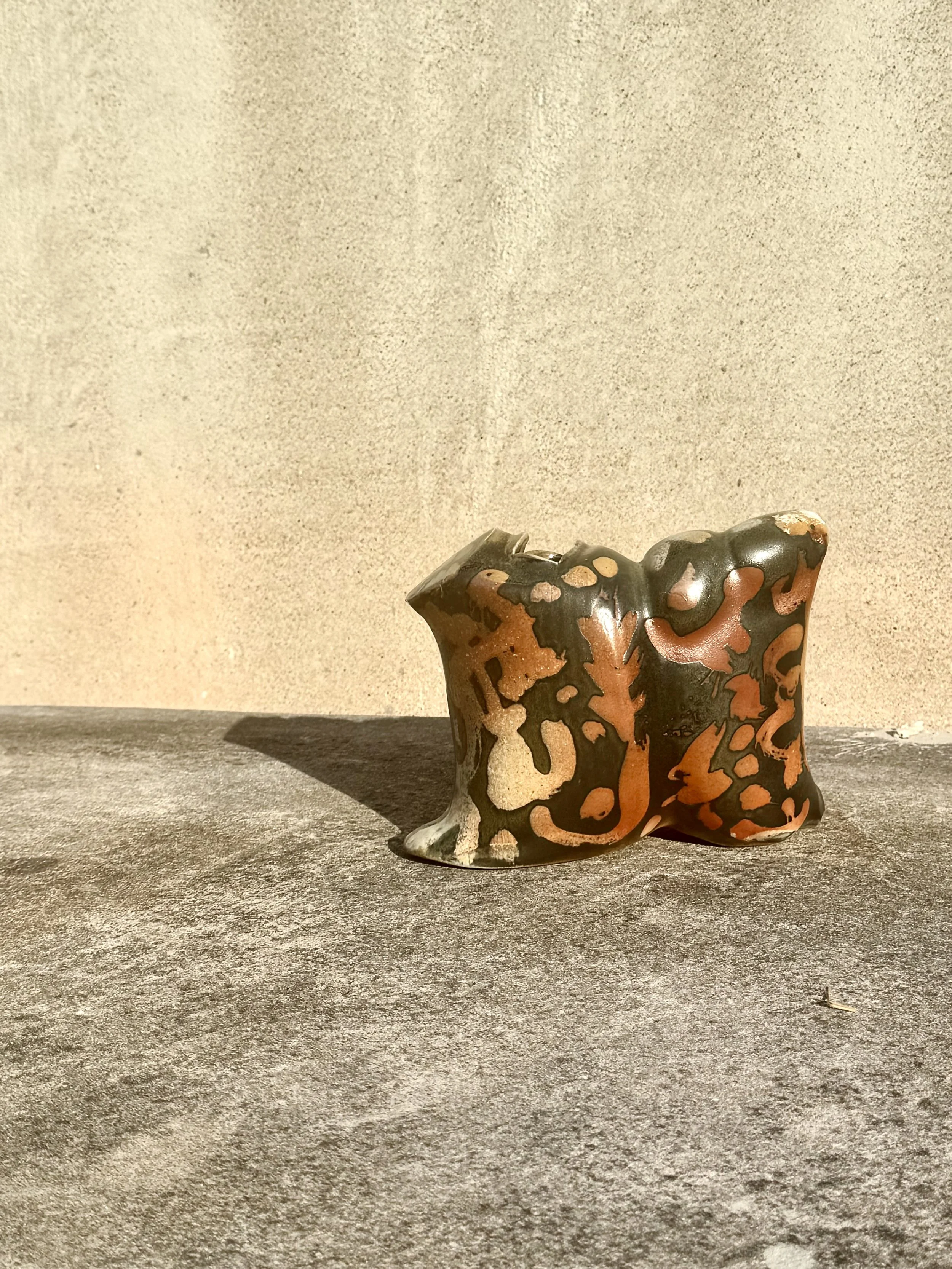
My process is direct. I cut into a wall and open it. I compress a side until the volume shifts. I oval a cylinder so the interior pressure changes. I torque a rim until it stops reading as neutral. I tear a section and patch it back. I do not hide the repair. I want you to see where the body failed and what held it together after that.
The repair materials matter. My slip is plain, but I change it when I need it to perform under stress. I add vinegar when I want stronger adhesion and a different working time. I add paper fiber or insulation fiber when I need better strength at seams, edges, or patched areas. I started doing this because I was losing too many joins. Over time it became part of the work itself. The reinforcement is not cosmetic. It is visible evidence of what the form had to survive.
I keep coming back to the point where a piece is close to collapse. I do not mean accident for its own sake. I mean the point where the structure is under enough pressure that every next move matters. On the wheel, that is easy to read. If the wall is too thin, it shows up at once. If the base is weak, the upper section starts to drag it down. If the form is slightly off center, the rotation makes that obvious. I have had pieces slump in front of me and force a decision. I could push them back toward the first plan, or I could follow the failure and build from there. I usually follow it. I trust that more.
That choice comes out of lived experience, not theory. I have seen that staying intact is not always the same as staying true. I have also seen that damage changes posture, rhythm, and capacity, but does not erase a body. In the studio, a vessel can cave in, tilt, split, or lose some of its original function and still hold volume. It can still keep an interior. That matters to me. I think a lot about containment, but not in a neat functional sense. I mean the ability to hold memory, pressure, grief, contact, and time without denying what they did to the structure.
Surface carries that record further. My main surface language comes through wood firing, ash deposit, flashing, and atmospheric change. I do not use wood firing to make the work look rough or dramatic. I use it because it keeps the surface open to forces outside my hand. Ash settles unevenly. Heat shifts across the kiln. A patched seam may darken differently than an intact wall. A ridge can catch deposit while a recessed area stays dry. High alumina glazes help me control some of that response. I use them for density, dryness, and a restrained surface that does not blur the altered areas. At cone 10 reduction and in atmospheric firings, those choices become structural. The kiln tests joins, foot strength, wall tension, and any weakness I left in the piece.
Scale changes the reading. My forms run from about 6 to 30 inches. At the larger end, they stop behaving like small ceramic objects and start taking up space more like bodies. I noticed that people respond differently when a vessel reaches that scale. You do not just look down at it. You meet it. You read stance, weight, tilt, and strain. You notice whether it seems steady or compromised.
I make these forms as studies of pressure, adaptation, repair, and survival. Not as symbols in a broad sense. More because I have handled enough clay to see that structure changes under force, and enough life to know that people do too. When you look at the work, I want you to see what happened to the form. I want you to see where it was pushed, where it gave way, where it was patched, and what remained possible after that. I do not think wholeness always looks clean. I have not seen life work that way.